Guide
American Range vs Wolf: Which Pro Range Fits Your Kitchen?
A fair look at American Range vs Wolf ranges: burner and oven design, dual fuel vs gas, common wear parts, typical repair costs and local service.
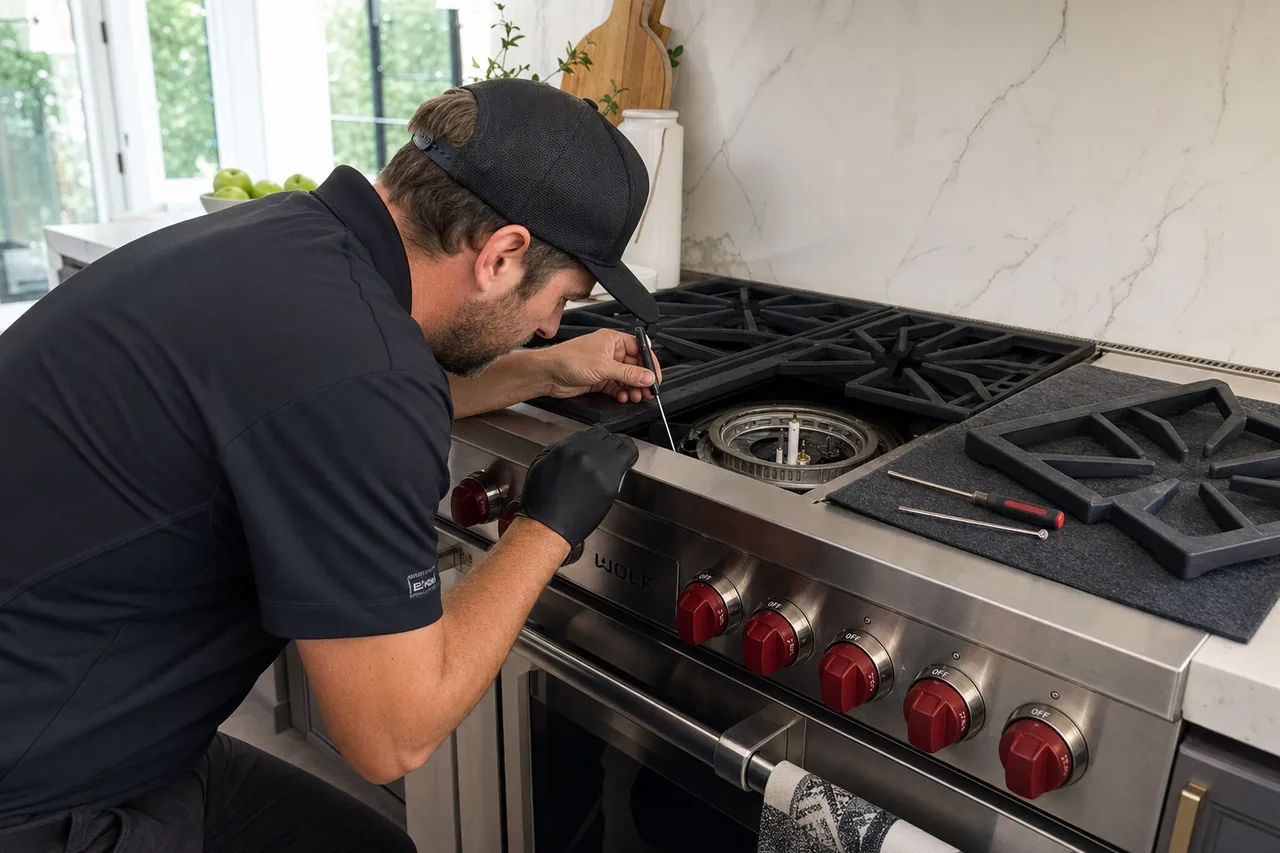
American Range vs Wolf comes down to design roots and support: American Range brings a commercial-kitchen build into the home, while Wolf is engineered around home cooking, with sealed, dual-stacked burners and a large base of local technicians who know it. Both are serious pro-style ranges, and when either one needs work, a typical range repair runs $250–$900, with the firm quote given on site after diagnosis.
Neither brand is a bad choice. The right pick depends on how you cook, how you clean, what your kitchen’s gas and electric lines can support, and how easily you can get the range serviced ten years from now.
How do American Range and Wolf differ in construction?
American Range started as a maker of restaurant cooking equipment, and its residential ranges keep that heavy, no-nonsense feel: thick steel, big knobs and grates built for pots that slide around all day. Burner style varies by model, so look closely at the cooktop you are considering and confirm whether the burners are open or sealed.
Wolf is the cooking brand of the Sub-Zero Group, and its ranges are designed for home kitchens from the start. The cooktop uses sealed burners in a one-piece top, continuous cast-iron grates and the familiar red knobs. The finish and fit are tuned for a living space rather than a restaurant line.
| Point | American Range | Wolf |
|---|---|---|
| Design roots | Commercial cooking equipment maker that also builds home ranges | Residential cooking line of the Sub-Zero Group |
| Burner style | Commercial-style; confirm open or sealed on the model | Sealed, dual-stacked burners |
| Cleanup | Depends on burner style; open burners drop spills into trays below | Spills stay on the sealed top and wipe off |
| Simmer control | Check the low setting on the model you want | Lower burner tier is built for gentle simmering |
| Service in Westchester | Smaller installed base; confirm local support before buying | Common in the area; most technicians see it often |
How do the burners and ovens compare for everyday cooking?
On a Wolf, each burner has two stacked tiers. The upper tier delivers high heat for searing and boiling, and the lower tier runs a small, gentle flame for sauces, rice and melting chocolate without a diffuser. That range from high to very low is the main reason home cooks choose it.
Commercial-style burners are built around strong, wide flames, which suits wok cooking, big stockpots and fast searing. Before you buy, turn a display model’s burner to its lowest setting and see whether it holds a steady, small flame. If you simmer often, that one test tells you a lot.
Both brands offer convection ovens. The bigger oven decision is usually the fuel: gas or electric. That brings in the most common follow-up question shoppers ask.
Wolf dual fuel vs gas range: which should you pick?
A Wolf dual fuel range pairs a gas cooktop with an electric convection oven. Electric ovens hold an even, dry heat, which helps with cookies, pastry and layer cakes. The trade-off is more electronics, such as a control board and temperature sensor, and the range needs a 240-volt circuit in addition to the gas line.
An all-gas range uses a gas oven. Gas ovens run a little more humid, which many cooks like for roasts and bread, and the electrical hookup is simpler. The common wear item is the oven igniter, which weakens over time and causes slow preheating before it fails outright.
If you bake weekly, dual fuel usually earns its place. If you mostly roast, braise and cook on the burners, an all-gas model keeps things simpler.
The same questions apply to other names shoppers compare against Wolf, such as Hestan or Café: burner design, oven fuel, and who will service it locally.
What tends to wear out, and what does it cost to fix?
Pro ranges from any brand use the same families of wear parts: igniters, spark modules, valves, sensors, gaskets and, on electric ovens, elements and control boards. How often they fail depends more on use and cleaning than on the badge. Spills that reach a spark igniter, heavy oven cleaning cycles and doors that get leaned on cause a large share of service calls.
The figures below are typical ranges for Westchester range work. The firm quote is given on site after diagnosis.
| Symptom | Likely cause | Typical range |
|---|---|---|
| Burner clicks nonstop or won’t light | Wet igniter, spark module or gas valve | $300–$650 |
| Gas oven slow to heat or won’t light | Weak oven igniter | $250–$500 |
| Electric oven (dual fuel) not heating | Bake element | $250–$500 |
| Oven temperature off by 25°F or more | Temperature sensor or thermostat | $280–$450 |
| Display errors or dead controls | Control board / electronics | $400–$850 |
| Heat escaping around the door | Door gasket | $150–$450 |
| Any fault, first visit | Diagnostic / service call | $95–$149 |
See our repair pricing page for the full list, or read how range repair works from first call to finished fix.
How do service and parts compare in Mamaroneck?
This is where the decision often gets made. Wolf ranges are common in Westchester kitchens, so technicians around Larchmont, Rye and New Rochelle see them regularly, and replacement parts are easy to identify and order. With a less common brand, the range may cook beautifully, but you should ask before buying who repairs it locally and how parts are ordered.
Installation matters too. Many Mamaroneck homes, from Larchmont Manor to the streets near the harbor, are older houses whose kitchens were wired and vented for a standard stove. A pro range often needs a larger gas line, a stronger hood and, for dual fuel, a dedicated 240-volt circuit. Plan those upgrades with your contractor before delivery day, whichever brand you choose.
Mamaroneck Wolf Appliance Repair is an independent service, not manufacturer-authorized. For Wolf range problems in Mamaroneck and nearby towns, call (914) 809-9382 and describe what the range is doing. You can also learn more about the brand on our Wolf page.
Frequently asked questions
Is Wolf better than American Range?
Neither is better for every kitchen. Wolf suits cooks who want precise low simmering and broad local service, while American Range suits cooks who want a commercial-style feel and high-heat cooking.
Is a Wolf dual fuel range worth it over an all-gas model?
It is worth it if you bake often, because the electric convection oven holds steady, even heat. It does need a 240-volt circuit plus a gas line, and it has more electronics to service over the years.
How much does a pro range diagnostic cost?
A diagnostic or service call typically runs $95–$149. The firm repair quote is given on site after the technician finds the cause.
How long should a pro-style range last?
A well-built pro range commonly gives 15 years or more of service with regular cleaning and prompt attention to small faults. Replacing worn igniters and gaskets early keeps bigger parts from working harder than they should.